World Bank
Evoke — Project-Based Learning Platform
About this project
Evoke is an online game the World Bank uses to build 21st-century and social innovation skills in young people. Players work through missions, submit evidence of what they did in their communities, and review each other’s work. In 2016 the World Bank adapted it for Colombia: students at Uniminuto University’s campus in Soacha, on the outskirts of Bogotá, would play it for a semester while working on challenges facing people displaced by the country’s internal conflict.
The World Bank brought in Mobility Labs in May 2016, with the pilot a few months away and several teams of designers, developers and consultants working from different plans. We ran a Strategy Alignment Day that merged those plans into one, then designed the screens and visual style for the platform the pilot ran on.
One plan for every team
Evoke had World Bank staff, outside designers and contract developers, each with their own documents of features, design ideas and timelines. We combined them into a single project plan with a feature roadmap and effort estimates every team could plan from.
Working backward from the launch date in one-week sprints showed what could make the first release and what would have to wait. Weekly demo days, feedback sessions and prioritization meetings kept the teams on the same list.
Designing the game
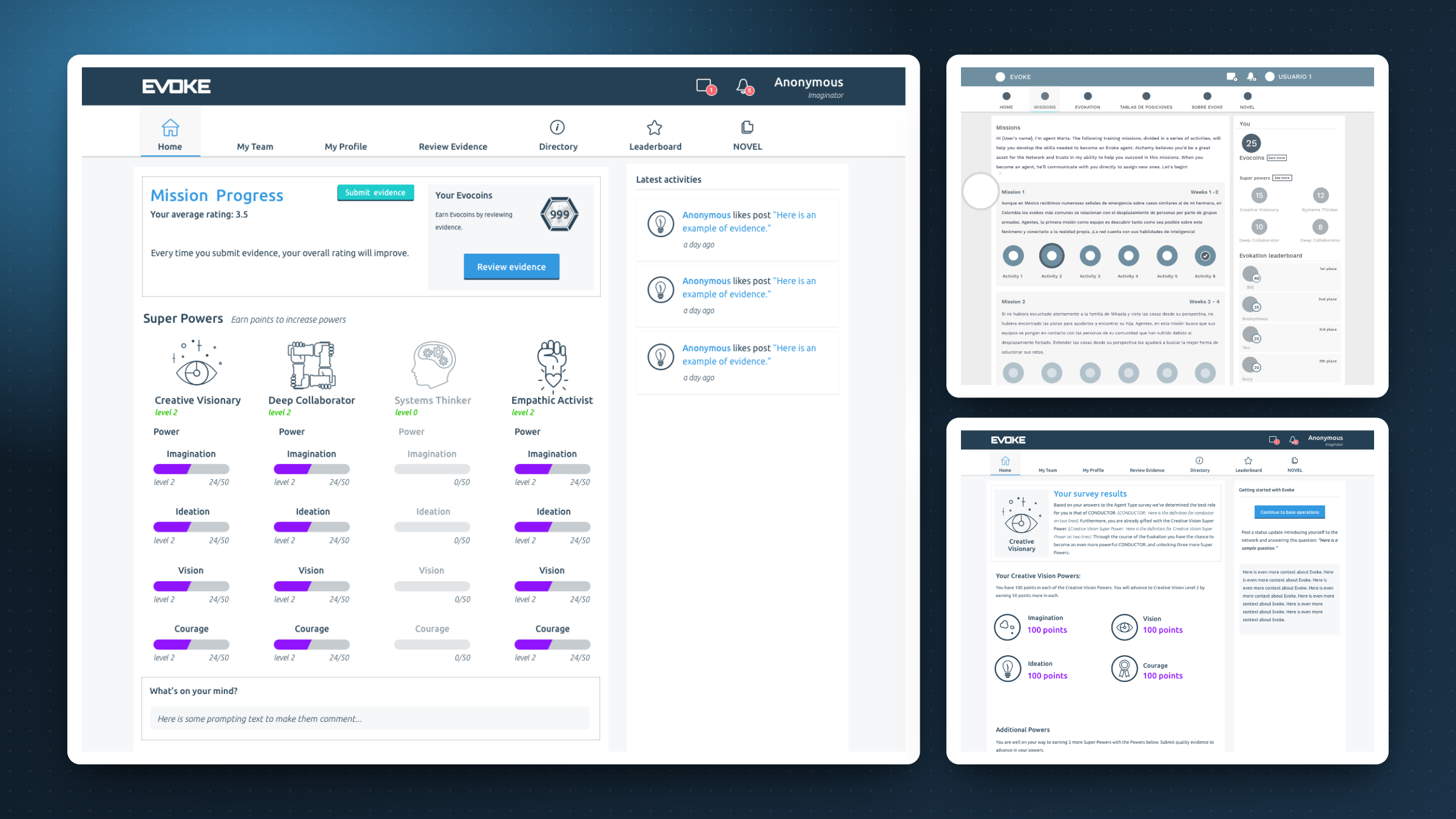
The platform ran on HumHub, an open-source social network, with modules built for Evoke. We designed the core screens and a style guide, and styled the platform to match.
- Missions: each player’s starting point, with the week’s mission, its activities and narrative from the game’s characters.
- Super powers: progress toward the four Evoke qualities (Creative Visionary, Deep Collaborator, Systems Thinker and Empathetic Activist), which grow as players earn points.
- Evidence review: a flow that asks players to review up to five classmates’ submissions at a time, with yes/no questions, a rating and comments.
- Evokations: a team page that tracks progress on the team’s final project.
- Evocoins and leaderboards that reward players for reviewing and contributing.
What the World Bank found
The World Bank evaluated the Soacha pilot with a randomized controlled trial. Over 16 weeks, from August to November 2016, 297 students in 14 classes either played Evoke or took one of two established social responsibility programs.
Students who played Evoke showed significantly greater gains in 21st-century and socio-emotional skills than either comparison group, an effect the researchers describe as medium. The gains held regardless of gender, ethnicity, age or field of study.
Source: Freeman and Hawkins, “Evoke – Developing Skills in Youth to Solve the World’s Most Complex Problems: Randomized Impact Evaluation Findings,” World Bank, 2017.
Our role
Mobility Labs led strategy alignment and UX and visual design, working with the World Bank’s Evoke team and its development contractors. Asked about the alignment day, a World Bank consultant on the project said the best part was “the focus it brought to what tasks had to get done before launch and in general the reigning in of ideas from all over the place.”
Key metrics
Students in the World Bank’s randomized evaluation
Weeks in the Soacha pilot
Sector
Government
Have a similar project?
Let's talk about how we can help you build something great.