Urban Institute
State of the Safety Net Tool
About this project
Millions of people who qualify for programs like SNAP, WIC, SSI and child care subsidies never receive them. The Urban Institute’s ATTIS microsimulation model estimates the size of that gap for every state, and how far poverty would fall if it closed. Urban needed a public tool that put those estimates in front of state policymakers, advocates and journalists.
Mobility Labs designed and built the State of the Safety Net tool between July 2025 and its launch in March 2026. It covers seven programs (CCDF, public and subsidized housing, LIHEAP, SNAP, SSI, TANF and WIC) and two tax credits (the EITC and CTC) across all 50 states, DC and the US as a whole. Its headline finding: if every eligible person received these benefits, 15.4 million fewer people would be in poverty, a 34 percent drop.
Visit apps.urban.org (opens in new tab)What the tool shows
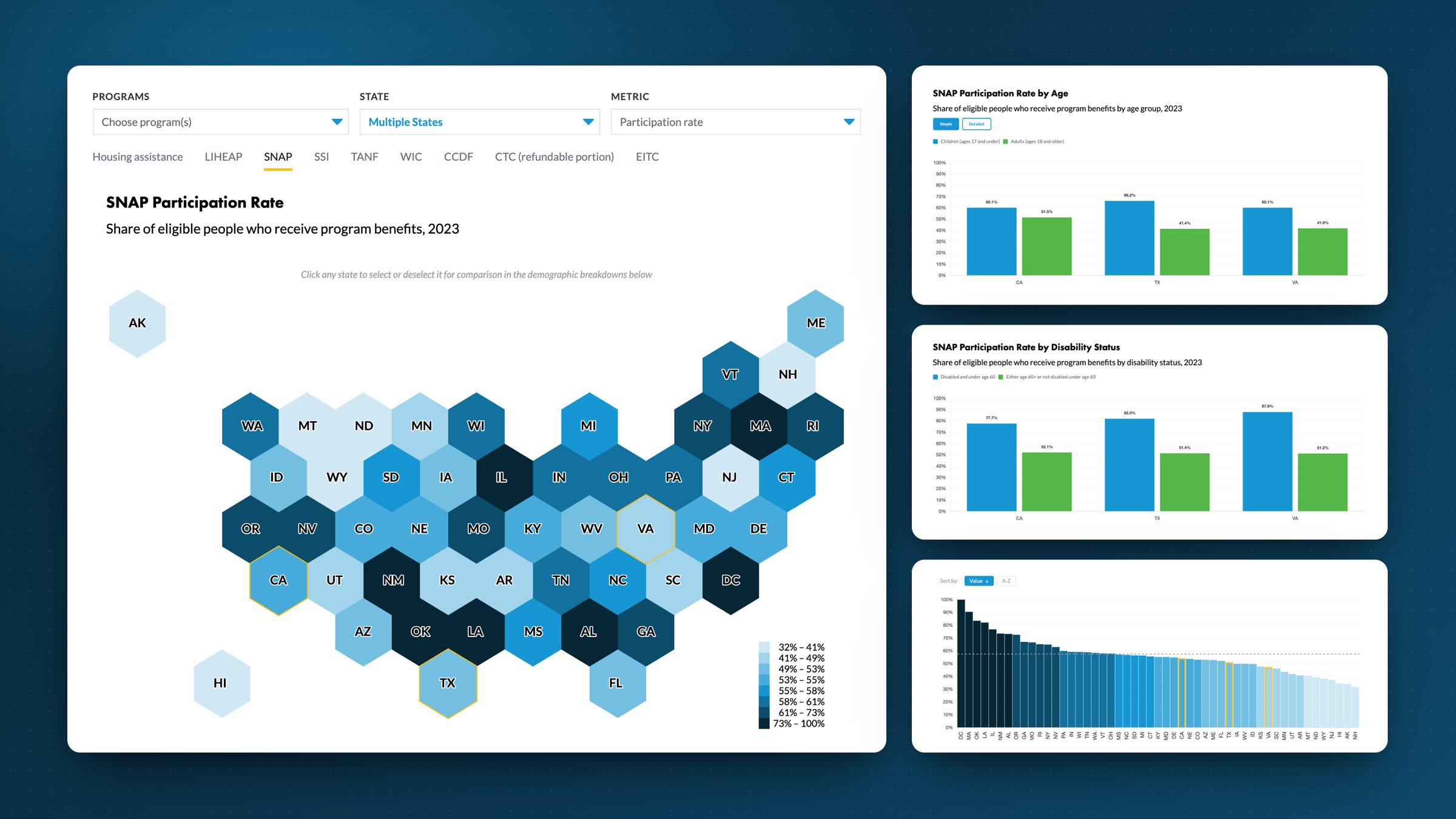
Readers start with poverty. A national map shows each state’s poverty rate under the Supplemental Poverty Measure today, then under a full-participation scenario. A second view shows the same comparison for children.
Each program then gets its own section with three measures: how many people are eligible, what share of them participate, and the gap between the two. Pick a state and every chart updates. Demographic breakdowns cover age, race and ethnicity, disability, citizenship and metro status, with a simple view for general readers and a detailed view for researchers.
Built to be shared
A tool like this does most of its work after launch, when people quote it. Every chart can be saved as an image with its title and notes attached, so the caveats travel with it. An embed generator lets newsrooms and advocates place any section on their own sites, and the underlying data can be downloaded.
One spreadsheet in, one dataset out
Urban’s researchers work in Excel. Each data delivery is a workbook of 36 sheets, one per program and measure. We wrote an import script that reads the workbook, skips the metadata sheets, normalizes missing values and state codes, and writes a single dataset of 52 rows (every state, DC and the US total) with 594 fields each.
A new data year is now one command rather than a hand-edited release.
Getting the details right
- Long methodology notes on every chart, kept next to the figure rather than in a footnote page, because the definitions change what the numbers mean.
- Charts built on Urban’s own dataviz component library and style guide, so the tool looks like Urban research.
- Automated tests on the data filters, run before every deploy.
- A static build deployed through Urban’s existing pipeline, with staging and production environments for review.
Our role
Mobility Labs led design and development. We worked with Urban’s project leadership, research team, ATTIS model programmers and editors through several rounds of review.
Key metrics
Programs and tax credits covered
States plus DC, each with its own view
Fewer people in poverty if every eligible person enrolled
Sector
Nonprofits
Have a similar project?
Let's talk about how we can help you build something great.